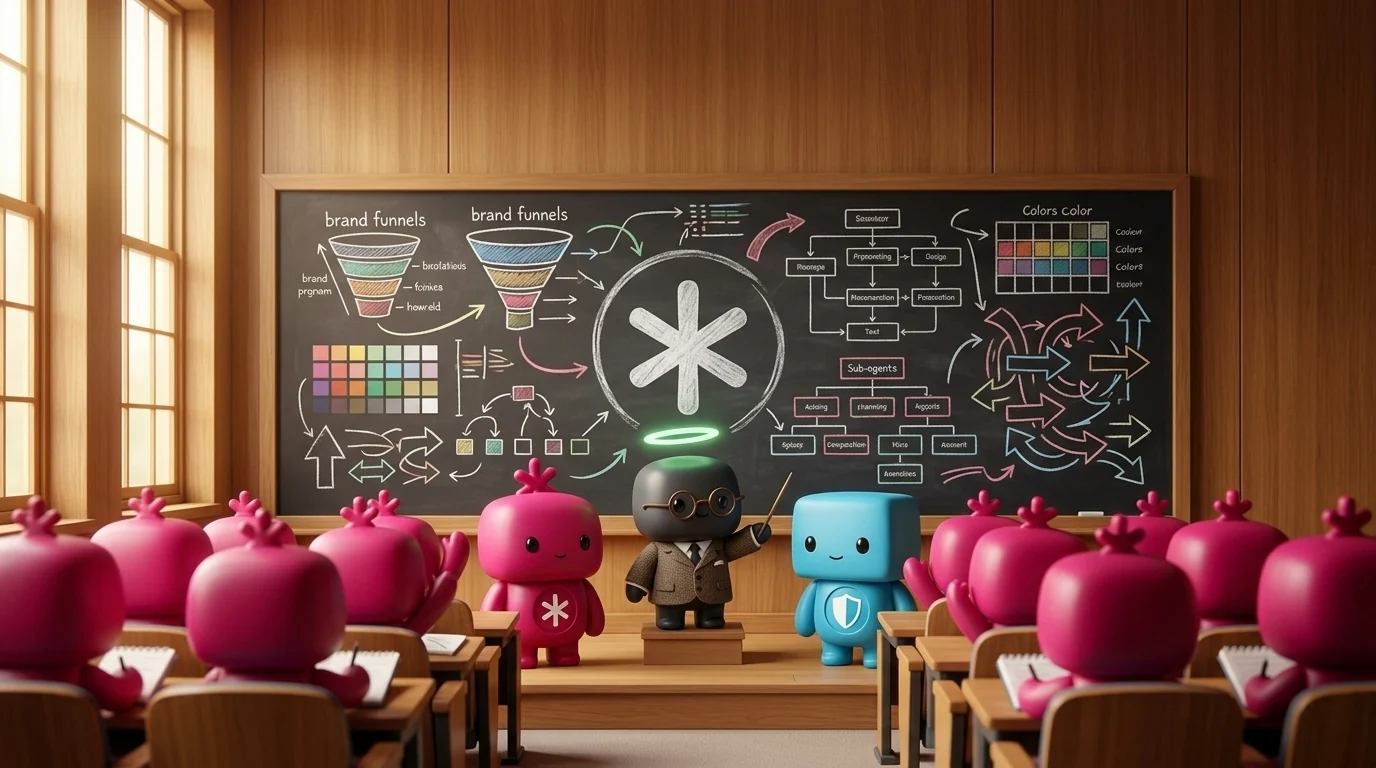

The Orchestrator agent, dressed as a professor, teaching Achilles, the Guardrail and the sub-agents about branding in a lecture hall

The system,
thinking out loud.

The agentic era, explained one idea at a time.

featured— the column and the monthly report
Achilles, the RDLB Agentic mascot the achilles angle · the column

AI, made legible, with a little wit.

Achilles and the cast explain the agentic era one idea at a time. Short reads, real insight, zero jargon.

Enter the column →
the dispatch

Get the notes in your inbox.

One useful note on brand systems, agentic workforces, and staying unmistakably yourself. No spam, no filler, unsubscribe anytime.

Written with the system. Approved by humans.

the field notes
01 · July 28, 2026

Your pilot worked. That is why the rollout failed.

Pilots run under conditions a rollout never gets. The gap is not the model. It is memory, enforceable rules, approval, and logs.

pilots · rollout · adoption
02 · July 27, 2026

The model went free. The doorway didn't.

Frontier weights are a download now. The thing still worth fighting over is where demand arrives.

Achilles Angle · Innovation Field Notes · Distribution · Agents
03 · July 26, 2026

Three times the output. The same pair of eyes.

When throughput triples, review becomes the constraint. Tiering, enforceable rules, and logs are what keep the gate from collapsing.

approval gate · review capacity · throughput
04 · July 25, 2026

We run on what we sell.

Everyone is selling agentic systems now. Here is ours, running in public, with receipts.

Achilles Angle · Build In Public · Agents · Process
05 · July 24, 2026

The brief is the unit of brand work.

Every piece of brand work starts as a brief. Treat the brief as the unit—structured, versioned, enforceable—and throughput compounds without the drift.

briefs · brand operations · throughput
06 · July 23, 2026

Every decision routes through you. That is the ceiling.

Founder judgment is the scarcest asset in the company. The ceiling forms when it is spent reviewing execution. How an approval gate changes the math.

founder bottleneck · approval gate · operating leverage
07 · July 22, 2026

The agent doesn't need your keys.

Most agent risk is access design, not model behavior. Read-only connectors, one approval gate, and audit-grade logs make autonomy safe to run.

read-only connectors · security · governance
08 · July 20, 2026

Volume doesn't kill a brand. Drift does.

This column is produced by an agentic system. Here's the machinery that keeps it from wandering.

Achilles Angle · Build-in-Public · Brand Systems · Agents
09 · July 16, 2026

A longer leash isn't the upgrade. The checkpoint is.

This week's agents can run for hours unsupervised. The feature that actually matters is how easily you can stop them.

Achilles Angle · Innovation Field Notes · Agents · Autonomy
10 · July 14, 2026

Open vs. closed models is the wrong first question.

Open or closed models is a routing decision, not an identity. Model-agnostic architecture matters more to a brand system than the model you pick this quarter.

model strategy · portability · architecture
11 · July 13, 2026

Nobody ships one agent. They ship a system.

A lone agent is a tool. The value is in the coordination around it.

Achilles Angle · Cybernetic Ecosystems · Agents
12 · July 9, 2026

What the first ninety days actually change.

Most brands judge an agentic system by its first asset. The real meter is the ninety-day slope: throughput climbs three to five times while cost stays flat.

throughput · rollout · enterprise value
13 · July 8, 2026

What 44,000 runs cost.

Thirteen agents. 44,000+ production runs in 63 days. Under $50 in model spend. What collapses when execution gets cheap, and what stays expensive.

cost structure · execution economics · agentic systems
14 · July 7, 2026

The brand remembers. The team doesn't have to.

Every approved brief and killed concept is a decision. Most brands lose them. A system that remembers turns each one into compounding leverage.

brand memory · decision architecture · brand operations
15 · July 7, 2026

Agentic marketing vs. marketing automation: memory is the difference.

Where marketing automation stops, what persistent memory changes, and three honest checks that tell you which system your team actually needs.

agentic marketing · marketing automation · agentic operating system
16 · July 6, 2026

Agentic marketing: what it actually is, and what it replaces.

A working definition of agentic marketing, the four-part mechanism behind it, and the tool stack plus manual assembly it retires.

agentic marketing · agentic operating system · marketing operations
17 · July 6, 2026

When everyone has the same models, taste is the moat.

The models are a commodity now. What you point them at isn't.

Achilles Angle · Brand · Taste
18 · July 6, 2026

If it isn't logged, it didn't happen.

Audit-grade logs turn agent output into evidence: what ran, what changed, who approved it. Trust in an agentic system is a record, not a feeling.

audit logs · governance · trust
19 · July 5, 2026

The system works. The team has to use it.

Most agentic projects do not fail on technology. They fail on adoption. A capability nobody trusts or uses returns nothing. The last mile is human.

adoption · change management · rollout
20 · July 4, 2026

The prize is not cheaper content.

Cheaper content is the smallest reward an agentic system offers. The real prize is operating leverage: more output per unit of judgment, without more headcount.

operating leverage · economics · enterprise value
21 · July 3, 2026

Every handoff is a tax. Agents don't pay it.

Every handoff between people loses context and adds wait time. How an agentic system carries context end to end and removes the coordination tax.

handoffs · coordination · throughput
22 · July 3, 2026

Lock-in is a bill that arrives later.

Vendor lock-in feels free at signing. The bill arrives when the model changes, the price moves, or you want to leave. Portability is the hedge you buy now.

vendor lock-in · portability · architecture
23 · July 2, 2026

Your next buyer asks a model first.

Buyers now ask an assistant before they visit your site. If a model cannot read your brand clearly, it recommends someone it can. That is a systems problem.

answer-engine optimization · AEO · brand discovery
24 · July 1, 2026

What the approval gate is worth.

The human approval gate looks like friction. Priced correctly, it is the cheapest control in an agentic system and the one that protects every other line.

approval gate · governance · economics
25 · June 30, 2026

Your agent isn't stupid. It's underbriefed.

When an agent fails, the fix is rarely a smarter model. It's usually a fuller brief.

Achilles Angle · context engineering · agentic systems · reliability
26 · June 29, 2026

Your institutional memory walks out the door.

When people leave, your brand's accumulated judgment leaves with them. An agentic system holds the decisions, briefs, and voice rules in place.

institutional memory · employee turnover · continuity
27 · June 29, 2026

You can't trust an agent you can't measure.

A demo shows it worked once. A test set shows it works when you're not watching.

Achilles Angle · evaluation · agentic systems · reliability
28 · June 28, 2026

A swarm of agents beats a smarter one.

One capable agent still guesses. A swarm proposes, checks, and keeps the best — the orchestrator-worker pattern, and how to run it without the bill running you.

swarm workflows · orchestration · agentic systems
29 · June 26, 2026

Brand voice works only when it's enforceable.

A brand voice document describes the voice. It does not enforce it. Here is how voice becomes rules a system applies to every output, every time.

brand voice · enforcement · brand operations
30 · June 25, 2026

What to ask before you buy an agentic system.

Most agentic systems get scored on the year-one fee. The questions that predict whether one will serve your brand are about exit, control, and memory.

evaluation · procurement · governance
31 · June 23, 2026

What to agentify first, and what to never agentify.

Not every task belongs on an agent. A practical order of operations for what to automate first in a brand system, and what to keep firmly human.

agentification · brand operations · prioritization
32 · June 22, 2026

Most of your advantages are temporary.

Capital, talent, and culture are temporary edges. Real advantage is structural: proprietary data and a system that compounds it. A Columbia view.

competitive advantage · data moat · institutional memory
33 · June 21, 2026

What the system does before you wake up.

A look at what an agentic brand system completes overnight, why a system beats a tool, and where the founder still owns the final yes.

a day in the system · agents · throughput
34 · June 20, 2026

Taste and throughput are not a tradeoff.

Volume is cheap; taste is scarce. How a written standard and a human approval gate let a brand scale output three to five times without lowering the bar.

taste · throughput · brand operations
35 · June 19, 2026

Why pilots stall and rollouts ship.

Agentic pilots fail on operating problems, not model quality. How read-only access, audit-grade logs, and a human gate turn a demo into a rollout.

pilots · rollout · evaluation
36 · June 18, 2026

The brief is the unit of brand work.

Brand work moves at the speed of its briefs. Treat the brief as the asset and an agentic system can run it at scale without losing your voice.

briefs · brand operations · throughput
37 · June 17, 2026

The founder is your brand's bottleneck.

The most expensive work in a founder-led brand is judgment, and it lives in one head. How an agentic system encodes it and lifts the throughput limit.

founder bottleneck · delegation · throughput
38 · June 13, 2026

The interface is disappearing. Brand work changes with it.

The dashboard was a workaround for the fact that humans couldn't talk to systems. As that changes, where does brand work actually happen?

future of work · agents · adoption
39 · June 12, 2026

Analytical software is fading. Systems that act are what's next.

When a model can read your data directly, a dashboard that only summarizes it becomes a tax. What replaces the analytics layer for brand operations.

economics · systems · software stack
40 · June 11, 2026

Your proprietary data is the moat. Most brands waste it.

General models know everything and nothing about your brand. The defensible advantage is the data only you have — captured, structured, and recalled.

institutional memory · data moat · defensibility
41 · June 10, 2026

Single point of failure: the risk in your AI stack nobody prices.

If one vendor's policy change can break your brand operation overnight, you have a dependency, not a system. How to design the risk out.

vendor risk · architecture · resilience
42 · June 9, 2026

Open or closed: choosing the models under your brand system.

The model layer is a decision, not a default. How to weigh frontier performance against control — and why the choice should live with you, not a vendor.

model-agnostic · architecture · governance
43 · June 8, 2026

Read-only by default: the security posture for agentic systems.

Agents beside your systems, never inside them. Why sovereign runtime and scoped connectors are what let legal sign off in week one.

security · connectors · posture
44 · June 7, 2026

What 90 days buys: from audit to operating system.

The flagship engagement, week by week: signal in, judgment through, work out — wired into your business and owned by your team at the end.

90-day system · offer · process
45 · June 6, 2026

The real cost of your content operation.

Most brands pay twice for the same work — once for the team, again for tools nobody operates. How to find the number, and what a system changes.

economics · content operations · roi
46 · June 5, 2026

Why your brand system should not marry a model vendor.

Models change quarterly; your brand does not. The architecture that lets the system upgrade automatically while the brand layer holds.

model-agnostic · architecture · vendor risk
47 · June 4, 2026

The human gate: governance that makes agents safe to ship.

Autonomy is not the goal — governed throughput is. How approval gates, audit logs, and scoped access keep an agentic system worth trusting.

governance · security · human gate
48 · June 3, 2026

What an agentic brand audit actually covers.

Two to three weeks, no retainer: mapping your highest-cost work, scoring it for agentification, and handing you the build plan — whether or not you build with us.

agentic brand audit · offer · process
49 · June 2, 2026

Machine legibility: how AI agents read your brand.

AI agents now research and shortlist brands before a human loads a page. What they read, what they skip, and how to be the safe recommendation.

machine legibility · AEO · agentic commerce
50 · June 1, 2026

Brand consistency is a systems problem.

Voice drift is not a talent failure — it is what happens when consistency depends on memory. The mechanism for sounding like yourself at scale.

brand voice · consistency · systems
51 · May 31, 2026

The agentic workforce, explained for founders.

Agents are roles, not chatbots: named operators with schedules, handoffs, and outcomes. How a 12-operator workforce divides real brand work.

agentic workforce · agents · foundations
52 · May 30, 2026

What a brand operating system actually is.

Not a tool, not a retainer — a governed system of agents that holds your voice, reads your market, and produces continuously. The mechanics, plainly.

brand operating system · agentic workforce · foundations